

Precision CNC Machining Slender Shafts: How We Control Deflection (Without Going Crazy)
Let's be honest. If you ask any machinist on our shop floor what part they hate running most, they won't say a complex 5-axis aerospace impeller. They'll probably point to a simple-looking slender shaft.
Just last month, a customer brought in a real horror show of a part. We used a 316L stainless steel shaft. It looked more like spaghetti than a machined component. Its Length-to-Diameter (L/D) ratio was pushing 35:1.
When your L/D ratio goes past 10 or 12, the lack of rigidity means the metal behaves like a wet noodle. If your supplier lacks the right skills, you may get tapered parts, rough finishes, and pieces that bend after machining. We've seen buyers come to us asking for help. Their last low-cost supplier shipped 2,000 shafts that looked like bananas.
Here is a clear look at what works for us on the shop floor. It helps reduce deflection, vibration, and thermal expansion when machining slender parts. No textbook theories-just real shop-floor fixes.
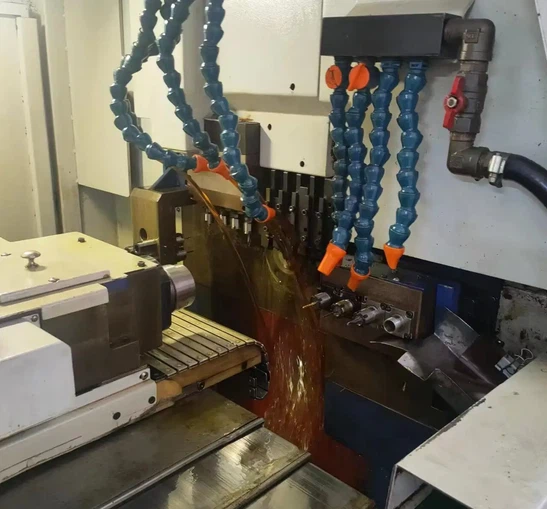
Why Do Slender Shafts Fail So Often? The Physics Behind the Headache?
It all comes down to physics. When you drag a carbide cutting tool across a long, unsupported metal piece, you face three major challenges at once.
1. Radial Deflection (The "Bow" Effect)
During turning, the cutting tool creates axial force that moves along the workpiece length. It also creates radial force that presses into the part's side. Because the shaft is thin and long, it lacks the beam stiffness to resist that radial pressure. It literally bends away from the tool.
The result? The tool cuts less material in the middle of the shaft than at the ends. You end up with a barrel or "drum" shape-thick in the middle, thin at the ends. Physics wins every time if you don't support it right.
2. That Screaming Chatter (Harmonic Vibration)
If you've spent any time in a machine shop, you know the sound. a high-pitched squeal that means your tool is bouncing off the material instead of slicing it.
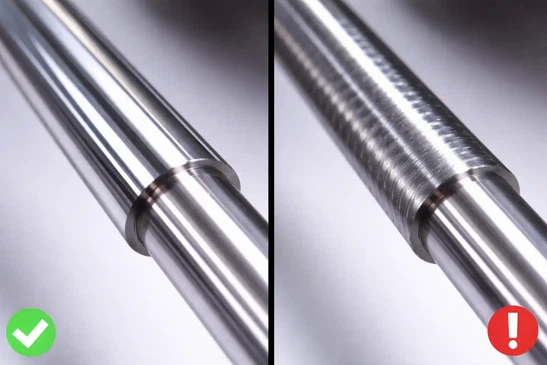
Poor rigidity leads to high-frequency harmonic vibration. This chatter ruins your surface finish and leaves ugly tiger-stripe marks. It can also chip your costly carbide inserts within minutes.
3. Thermal Expansion (The Silent Killer)
Metals grow when they get hot. Cutting a long shaft generates a massive amount of friction and heat.
For example, a 500mm length of aluminum can easily grow several thousandths of an inch just by getting warm to the touch. If a rigid chuck and a rigid tailstock lock that shaft tight, the extra length has nowhere to go. It has to buckle and bow outward.
The Ultimate Fix: Swiss-Type CNC Machining
If we use a thin shaft that is under 32 mm (about 1.25 inches) in diameter, the L/D ratio may be high. In that case, we do not use standard CNC lathes. We move the job straight to our Swiss-Type CNC machines (like our Citizens or Tsugamis).
I'll be straight with you: Swiss machining is the ultimate cheat code for slender shafts.
Why? It's all about the Guide Bushing.
Unlike a conventional lathe, where the workpiece extends from the chuck, a Swiss machine works the opposite way. A highly precise guide bushing feeds the raw bar stock through. The cutting tool sits stationary, right next to that bushing-usually just a millimeter or two away. The material slides out, and the tool slices it as it emerges.
Because the tool cuts right next to the support, the L/D ratio at the cut point is near zero. Deflection disappears completely. Chatter is dead.
With Swiss-type machining, we maintain tight diameter tolerances of ±0.005 mm (0.0002 inches) and Ra 0.4 finishes.
We do this on parts that many other shops refuse to quote. Plus, we can mill flats, drill cross-holes, and tap threads all in one single setup, which drastically handling errors.
Traditional Lathe Tips (When the Workpiece is Too Large for a Swiss)
Swiss machines are incredible, but they max out at certain diameters. If a customer sends us a custom pump shaft that is 50mm in diameter and 800mm long, it won't fit in a Swiss lathe. We have to rely on conventional CNC turning centers.
Here is how we stop large slender shafts from turning into bananas:
1. Steady Rests vs. Follower Rests
You have to support the middle of the cut.
· The operator fixes a Steady Rest to the machine bed. It holds one specific spot on the shaft while the tool cuts elsewhere. Great for drilling the end of a long shaft, but not perfect for long turning passes.
· A Follower Rest bolts right to the tool carriage. It travels with the cutting tool, constantly supporting the shaft directly opposite the cutting forces. This is effective, but setting the follower rest rollers so they don't scratch the new cut surface takes an expert machinist.
2. Reverse Feed Turning (The Tension Trick)
Usually, you start cutting at the tailstock end and feed the tool toward the chuck. This puts the thin shaft under compression. Bad idea.
Instead, we program the machine to start near the chuck and cut backwards toward the tailstock. This puts the shaft under pulling tension. Think of it like pulling a guitar string tight-it naturally wants to stay perfectly straight.
3. Twin-Turret Pinch Turning
If we are running the job on a twin-turret CNC lathe, we use Pinch Turning. We program an upper tool and a lower tool to cut opposite each other at the time.
One tool takes the roughing pass, the other trails slightly for the finish pass. The radial pushing forces cancel each other out completely. The shaft doesn't even know someone pushes it.
4. Spring-Loaded Live Centers & Tailstock Pressure
To fight that thermal expansion I mentioned earlier, we never use a dead solid center. We use live centers with an internal spring in the tailstock.
As the shaft heat and grows during a heavy roughing pass, the spring occupies the extra length. It keeps the holding pressure constant and prevents the part from buckling.
Also, lowering the hydraulic tailstock pressure is crucial. Too much pressure on a 10 mm shaft will bow it. This can happen before the tool even touches it.
Tooling Geometry Secrets: What Inserts We Actually Buy
You can have the best machine in the world, but if you hit a slender shaft with the wrong carbide insert, you will have a bad time. Here's what our tool crib looks like for these jobs:
· Tiny Nose Radii: Standard inserts often have a 0.8mm or 0.4mm nose radius. For slender shafts, we drop that down to 0.2mm (0.008") or even 0.1mm. A larger radius acts like a snowplow, creating massive radial pressure that pushes the part away. A sharp, tiny radius acts like a scalpel, lowering cutting forces.
·High Positive Rake Angles: We ditch the heavy, negative-rake roughing inserts. We use high-positive, razor-sharp aluminum-cutting inserts, even on steel sometimes, to shear the material cleanly. It helps prevent tearing.
· Wiper Inserts (The Finish Hack): Normally, a tiny nose radius gives a bad surface finish. Unless you slow the feed rate to a crawl.
To fix this, we use "Wiper" inserts. They have a secondary flat edge that acts like a trowel, smoothing out the feed marks. This lets us run a tiny radius for low pressure, while still getting a polished finish at decent speeds.
Material Selection Guide for Slender Shafts
Every metal behaves differently when you stretch it out and try to cut it. If you are an engineer picking a material, read this first:
· 304 / 316 Stainless Steel: A nightmare if not handled right. It work-hardens rapidly. If your tool rubs instead of cuts, the surface becomes glass-hard, and the part bows immediately. Needs extremely sharp tools and flood coolant.
· 17-4 PH Stainless Steel: Actually much better than 300-series for long shafts. It machines beautifully in its annealed state and stays surprisingly straight.
· Titanium (Grade 5): It's gummy and doesn't conduct heat well. The heat stays in the cutting zone, which means the tool burns up, and the shaft pushes away. Requires extremely low cutting speeds and high-pressure coolant blasting right at the cutting edge.
· Cold-Rolled Steel (e.g., 1018 CR): The most common trap. Cold rolling packs the outer skin of the bar with immense internal stress. When we machine off the outer skin, stress releases unevenly, and the shaft warps as soon as it leaves the machine. Always specify Hot-Rolled or Stress-Relieved stock for long shafts!
A Quick DFM Favor to Ask Engineers
To the design engineers reading this: we enjoy making your components. If you specify a long, thin shaft, keep these simple Design for Manufacturability (DFM) tips in mind. They will make the part significantly cheaper and faster for us to machine for you.
1.Loosen Up the Middle: The chuck and center hold the ends of your shaft rigidly. They are easy to hold tight tolerances on.
The middle is where the part wants to bow. If the middle section will not fit against a bearing, pulley, or seal, please use a looser tolerance there. For example, use ±0.1 mm instead of ±0.01 mm. It saves us hours of fighting the machine, which saves you money.
2.Watch the Keyways: Milling a deep, long keyway along a long shaft releases internal stress. It can warp at once when it reaches the milling center. If you need a long keyway, design two symmetrical keyways, one on each side, to balance stress relief.
Or plan to pay for extra straightening and stress-relieving heat treatments.
3.Avoid Threads in the Dead Center: Single-point threading puts a lot of side pressure on the part. Try to keep threaded sections near the ends of the shaft where the rigidity is highest.
Real-World Case Study: Saving a Medical Device Project
Let's put all this theory into reality.
· The Part: An Endoscopic instrument shaft.
· Material: 316L Stainless Steel.
· Specs: 4mm diameter, 150mm length (An L/D Ratio of 37.5:1!).
· The Problem: The client's previous supplier was scrapping nearly 40% of the parts. They could not meet the strict 0.02 mm straightness callout. Chatter marks caused the parts to fail biological cleaning validations.
· Our Fix: We immediately dropped this job onto our 5-axis Citizen Swiss lathe. To stop a slight harmonic vibration on the tip during the final cut, we adjusted our 2,000 PSI coolant lines.
We aimed them at the exact cutting zone. This reduced thermal growth. We also swapped to a custom-ground high-positive rake wiper insert.
· The Result: We shipped a batch of 2,000 pieces a week later. The inspection reports from our optical CMM showed zero taper. The client had a 100% yield rate on their assembly line.
Conclusion
After years on the shop floor at Dazao, I can tell you one thing. Machining a long, thin shaft will humble you fast if you don't respect physics.
You just can't chuck a piece of raw cold-rolled steel into a standard lathe, hit the green button, and pray it comes out straight. It simply doesn't work. Physics will win that fight every single time.
At Dazao, we've actually built a huge chunk of our reputation on handling these exact nightmare jobs. We do it by aggressively managing every tiny variable. Whether my crew runs your job on our high-end Swiss machines to remove deflection, we do not rely on luck.
Whether we dial in a twin-turret pinch cut, we do not rely on luck.
Or we swap tooling for a razor-sharp 0.1 mm radius insert to stop chatter.
We never let results come down to luck. We know how the metal wants to move, and we stop it before it does.
But look, I know how frustrating designing and sourcing these parts can be. I talk to fed-up engineers and buyers every week. Their supplier just shipped another batch of bent shafts.
Because of that, I see the same specific, hair-pulling questions coming up over and over again. So, before you click away, let's dive into the real answers to the most common slender shaft headaches I see out there.

Shop Floor FAQs: Answering the Hard Questions
Q1: Why does my slender shaft warp after I take it off the machine, even if I used a tailstock and it measured perfectly in the chuck?
A1:Internal stress. That's a killer.
If you turn cold-rolled steel, the steel mill traps stresses in the outer layer. Once you cut that skin off, the stress releases. The moment you unclamp the chuck, the part bows in your hand.
Fix: Stop using cold-rolled stock for long parts. Use hot-rolled, annealed, or buy pre-stress-relieved materials.
Q2: How do I stop that terrifying chatter when turning the exact middle of the shaft?
A2:Chatter means your radial tool pressure is beating the shaft's rigidity. First, drop your insert's nose radius down to 0.1mm. A tiny radius drastically lowers radial pressure.
Second, make sure your tool is exactly on center height (or even a hair above center for outside turning). If that fails, try "Segmented Turning."
Plunge and cut the shaft in short, full-depth sections. Move toward the chuck. Do not take long, shallow passes across the whole part.
Q3: My steady rest is leaving nasty track marks and scoring on the surface. How do I fix it?
A3:Chips probably catch under your standard metal rollers, or the clamping pressure feels too high.
Fix: Try turning a smooth, slightly oversized track first. Then wrap that spot with a layer of brass shim stock. Engage the rollers after that. For super delicate finishes, swap the steel rollers out for custom bronze or Teflon (PTFE) tips.
Q4: Is Swiss machining always the answer for slender shafts?
A4:Nope. Swiss machines are incredible, but they have two drawbacks: Size and Setup time.
They max out around 32mm to 38mm. And setting up the guide bushing and tooling for a Swiss is complex and time-consuming.
If you only need a small prototype run of three parts, a Swiss machine setup is overkill. It costs time and money.
Instead, use an experienced traditional machinist. Have them run a standard lathe with a solid follower rest.
Q5: Can programming tricks alone fix deflection if I don't have a steady rest or a Swiss?
A5:To an extent, yes. Aside from the reverse-feed trick I mentioned earlier, you can use SSV (Spindle Speed Variation) in your G-code. By programming the spindle to speed up and slow down by about 10-15% during cutting, you disrupt the resonance that causes chatter. It sounds weird when the machine runs, but it works like magic.
Q6: How do you drill a center hole in a tiny 3mm shaft without bending it instantly with the drill bit?
A6:You can't just shove a center drill into a tiny, free-hanging wire. You have to support it perfectly. If you are not using a Swiss machine, you will need a custom split brass bushing.
Place it in the spindle to hold the tip fully rigid while you spot the center hole. Without a guide, the drill will just push the part aside and break.
Q7: Does coolant matter that much for long shafts, or is it just for tool life?
A7:It matters entirely for dimensional stability. A 500mm piece of stainless steel will easily grow by 0.1mm just from getting warm to the touch. If you lock it between centers, that growth forces it to bow sideways.
You need high-pressure, high-volume flood coolant on the tool tip. This keeps the shaft's core fully frozen during the entire cut.
Q8: Can you grind slender shafts to hold tight tolerances after turning?
A8:Yes, and it's highly recommended. Centerless grinding is our go-to secondary operation for slender shafts. Because a regulating wheel and a work blade support the part along its full length.
The part will not bend as it passes through the grinding wheels. how we get mirror-like finishes and micron-level accuracy without inducing new stresses.


