

In custom CNC machining, the difference between a prototype that fits and a wasted budget often comes down to measurement uncertainty. For project managers and mechanical engineers, a scrap part is more than a material loss.
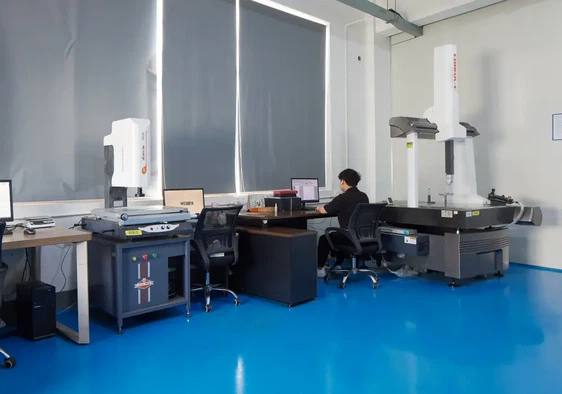
It causes production delays. It also raises the project's Total Cost of Ownership (TCO). At Xiamen Dazao Machinery, we use Coordinate Measuring Machine (CMM) technology as more than a final quality check. We also use it as a proactive engineering tool to ensure the dimensional accuracy of every part we produce.
By integrating CMM inspection into our CNC manufacturing process, we shift from reactive inspection to zero-defect manufacturing. This approach is key to meeting ISO 9001 quality standards. It also helps maintain the batch consistency needed in automotive, aerospace, and robotics.
How CMM Inspection Reduces TCO for Custom CNC Machined Parts
Many suppliers treat inspection as an afterthought. However, if you miss a deviation during the First Article Inspection (FAI) phase, an entire batch may need rework.
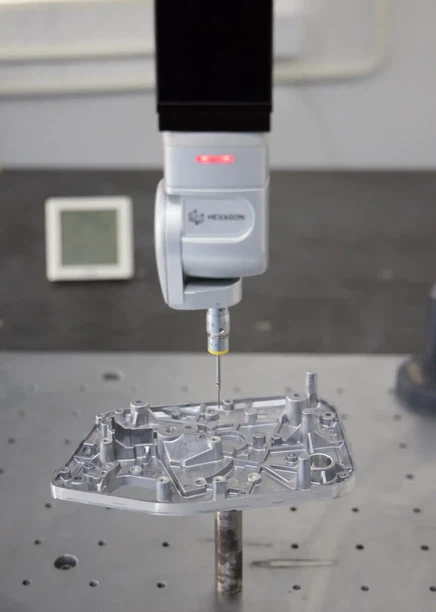
A CMM captures millions of data points across a component. This lets us verify complex Geometric Dimensioning and Tolerancing(GD&T) requirements. Manual tools like calipers or micrometers cannot measure them accurately. When you work with a manufacturer that uses strict dimensional checks, you reduce the risk of late assembly failures.
Why Dimensional Accuracy Matters in Global CNC Supply Chains?
For engineers working on high-performance robotics or aerospace hardware, "close enough" is never acceptable. A deviation of just 0.05mm can cause mechanical binding or vibration issues. Utilizing a CMM provides the process validation necessary to guarantee that every unit in a 10,000-piece batch adheres to the original CAD comparison specifications.
Common CMM Inspection Pitfalls in Precision CNC Manufacturing
Precision is only as good as the measurement methodology. Incorrect use of a CMM can cause "ghost" errors. These readings may suggest a component is out of tolerance. In fact, it may meet spec, or the opposite may be true.
1. Avoiding Probe Compensation Errors in CMM Measurement
If you enter the probe diameter incorrectly in the CMM software, the system uses the wrong offset. This causes a consistent error in all measurements. Our protocol requires daily master sphere calibration. This ensures the ruby tip's effective diameter is accurate within ±0.0001".
2. Solving Fixture Design Issues and Elastic Deformation
For high-tolerance thin-walled components, clamping force can induce temporary elastic deformation. If you measure the part while it distorts, you get invalid data. We utilize custom soft-jaw fixtures designed to hold the workpiece securely without exerting localized stress that affects geometry.

3. The Impact of Thermal Environment on CMM Measurement Accuracy
Metals expand and contract with temperature. A difference of even 5°C can shift dimensions beyond the tolerance band of a high-precision part. Our inspection room stays at 20°C (±1°C) to ensure the CMM report shows the true, stable material dimensions.
How to Avoid CMM Programming Bias in Precision Measurement?
One common frustration in engineering forums (like r/Machinists) is a mismatch. It happens between a supplier's measurement and a client's internal inspection. This is often not a mechanical error, but a "Programming Bias."
Different CMM programmers may choose different alignment strategies (e.g., iterative alignment vs. CAD-based datum alignment). If the alignment method at the factory and final assembly plant is not the same, two good parts can seem "out of spec."
At Dazao, we provide a CMM inspection report with a clearly defined alignment coordinate system. This helps your inbound QC team match our results 1:1. It also reduces "false failures" that waste your team's time.
Using CMM Data for DFM Optimization: A Guide for Mechanical Engineers
Many manufacturers guard their CMM data, but we use it for Design for Manufacturing (DFM) optimization. By analyzing the spread of measurements in a batch, we can find features that are often near the tolerance limit.
Often, these features are functionally irrelevant but geometrically difficult to machine consistently. When our CMM detects this pattern, we don't merely report it.
We also suggest design changes to the client. By loosening tolerances on non-critical features and tightening them on functional ones, we help cut manufacturing costs. We do this without reducing the performance of your custom machined parts. This collaborative data sharing transforms the CMM from a "policeman" into a tool for sustainable product development.
Advanced CMM Inspection & Data-Driven Quality Control
Modern CNC manufacturing process management is evolving. We have moved past simple "pass/fail" testing to a data-driven approach.
Leveraging SPC Analysis to Ensure Global Batch Consistency
By leveraging the data outputs from our CMMs, we conduct Statistical Process Control (SPC). This allows us to map the "process capability index" (Cpk) of our CNC machines. When a tool moves toward the upper limit of the allowed tolerance band, the system sends an alert. It prompts tool correction before any out-of-tolerance issue occurs.
Using CMM Data for Predictive CNC Machine Tool Compensation
This integration of CMM data back into the CNC program allows for "Predictive Machining." We don't just detect errors; we prevent them. By using the machine's internal compensation software, we adjust tool paths using the prior cycle's CMM inspection report. This ensures long-term batch consistency across the entire run.
Choosing the Right Dimensional Analysis Method for CNC Parts
Not every feature requires a CMM. Selecting the correct method optimizes lead time and cost.
|
Part Feature / Requirement |
Recommended Inspection Tool |
Rationale |
|
Simple Linear Dimensions |
Calipers / Micrometers |
Fast, efficient for basic tolerances |
|
Complex GD&T (Position, Profile) |
Contact CMM |
High accuracy for geometric features |
|
Free-form Surfaces / Intricate Curves |
3D Laser Scanning |
High data density for complex profiles |
|
Thin-walled / Fragile Parts |
Non-contact Optical Vision |
Eliminates mechanical pressure risks |
|
Threaded Features / Hole Depth |
Thread Gauges / Depth Gauges |
Reliable for fast, repetitive checking |
Understanding Your CMM Inspection Report: A Guide to GD&T
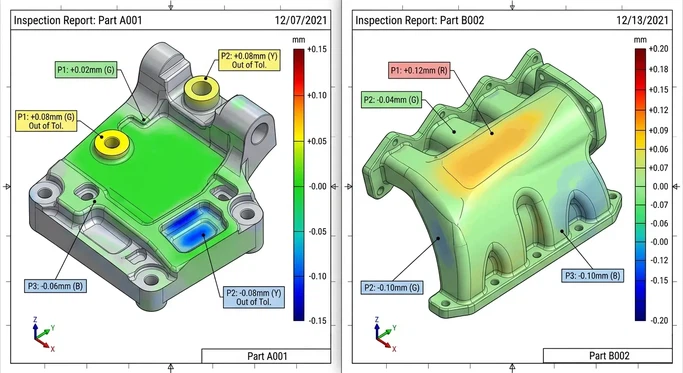
A common frustration for global clients is receiving a confusing inspection report. At Dazao Machinery, we believe in radical transparency. Our CMM inspection report includes:
Color Map Analysis: A visual representation (using red/green/blue) showing exactly where a part deviates from the nominal CAD comparison.
GD&T Summary: Clear verification of flatness, perpendicularity, and position callouts.
Traceability Data: Every report links to a specific machine, operator, and raw material batch number. This ensures full compliance with ISO 9001 audit requirements.
By understanding these reports, you can make informed decisions about your project's assembly tolerances and supplier performance.
Mastering Quality: The Xiamen Dazao Advantage
At Xiamen Dazao Machinery, we recognize that precision is the foundation of your engineering success. As a bespoke manufacturer and supplier, we follow strict ISO 9001 quality requirements. We do not treat the CMM as a nice-to-have. It remains a key cornerstone of our manufacturing mindset.
Our facility has several multi-axis CMM units. This allows us to handle complex, high-volume production.
We serve the medical and aerospace industries. We understand that your reputation relies on the performance of our parts. By combining our strong CNC machining with industry-leading inspection, we give global partners documented quality. This quality simplifies your supply chain management and lowers the total cost of quality.
When you choose Dazao, you are not just selecting a factory. You are adding a high-precision measurement partner to your development lifecycle. We bridge the gap between design intent and real-world parts. Your components arrive ready for assembly.

Frequently Asked Questions (FAQ)
Q1. Why is CMM inspection more reliable than manual inspection for CNC parts?
A:A CMM reduces human error from uneven contact pressure. It measures 3D shapes and complex GD&T with high accuracy. Manual tools often cannot capture these details. This helps ensure batch consistent results across batches.
Q2. How do you handle quality control for high-volume CNC machined parts?
A:We implement Statistical Process Control (SPC) using CMM data to monitor process stability. This lets us predict tool wear and apply needed offsets before parts fall outside the high-tolerance specification.
Q3. Can you perform reverse engineering using CMM data?
A:Yes. We use CMM data points to perform reverse engineering, generating accurate 3D CAD models from existing physical parts. This is vital for legacy part replacement or design optimization in the automotive and aerospace industries.
Q4. What is the difference between a contact CMM and a non-contact optical system?
A:A contact CMM uses a physical probe with a ruby tip to touch the part. highly accurate for measuring geometric features.
Optical systems use cameras or lasers for measurement. This method is faster and works well for delicate, small, or soft materials. These materials may bend under probe pressure.
Q5. How do you ensure the CMM itself is accurate?
A: Our CMMs undergo scheduled calibration traceable to national standards. We perform daily "Master Sphere" tests to verify probe performance. We keep our inspection area at 20°C to prevent thermal expansion errors.
Q6. Do you provide a CMM inspection report with every order?
A: Yes. For custom CNC machining projects, we provide a full FAI (First Article Inspection) report as standard. For full production runs, we can provide batch-specific inspection summaries upon request to satisfy your quality assurance requirements.
Q7. Can you measure custom machined parts that are large or heavy?
A: Yes, our facility has large-envelope CMMs. They handle heavy industrial components. They also keep the same micro-precision as smaller parts.
Q8. What happens if there is a discrepancy between my measurements and yours?
A: We prioritize collaborative resolution. We will review our CMM program alignment and probe compensation settings with your team. If a measurement difference comes from setup changes, we share our raw measurement point data. Your engineering team can then audit our verification method against your own.


